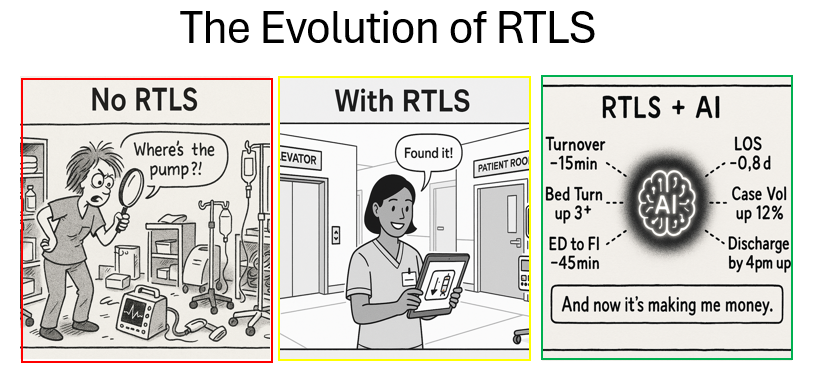
Your RTLS has been generating data for years. The problem is that nobody ever built a structured model of how your hospital is actually supposed to work — one that AI can reason about. Without that model, AI has no context.
Most hospitals bought RTLS to solve one problem. Find the IV pump. Protect the infant. Track the staff badge. And it works. For that one thing.
And that’s usually where it stops.
The Expansion Problem Nobody Talks About
Expanding RTLS beyond its original use case is genuinely hard. The nurse call system was a Facilities project. The staff duress buttons were owned by HR and Security. Infant protection was Clinical. Equipment tracking was Biomed. Each department solved their problem, checked the box, and moved on. Nobody had a mandate — or a model — to connect any of it.
That’s not dysfunction. That’s how hospitals have to work. The complexity of a health system demands division of responsibility. You can’t have one team owning everything. But the side effect is that technology gets purchased to solve problems, not build platforms. And RTLS, more than almost any other hospital technology, keeps paying the price for that reality.
The result: a sophisticated sensor network sitting in your ceiling, doing one thing.
So, What Changes That? AI. I Know — Shocker.
But not in the way you’re thinking. Not another dashboard. Not a predictive analytics module bolted onto your existing system. Not ChatGPT writing discharge summaries.
The problem was never the data. Your RTLS has been generating data for years. The problem is that nobody ever built a structured model of how your hospital is actually supposed to work — one that AI can reason about. Without that model, AI has no context. It can find patterns in your data, but it can’t tell you whether those patterns are helping you hit your goals or quietly working against them.
That’s the gap Precursor Agentic was built to close.
The Digital Shadow: Building the Model First
We spend 12 weeks building a Digital Shadow of your operation. Every workflow. Every handoff. Every goal, performance target, and dependency across every department that touches your RTLS. Not a process map on a whiteboard. A structured intelligence layer that AI can actually reason about — one that finally gives your sensor network the operational context it was never given at purchase.
Think of it as the operator’s manual your hospital never had. One that captures not just what your people, processes, and technologies do — but what they are supposed to achieve.
The Digital Reflection: Connecting the Model to Reality
The Digital Shadow tells you how your operation is designed to work. The Digital Reflection tells you how it actually works.
Once the Shadow is built, we connect it to your live operational data through a registry chain — linking each agent and goal in your model to the actual systems that support it. Your RTLS. Your OR scheduling system. Your CMMS. Your billing records. The model stays in the design-time planning horizon — this is not a runtime monitoring tool — but it draws on real performance data to measure the gap between designed intent and operational reality.
The insight isn’t “utilization is down.” It’s “this specific workflow is underperforming against its goal, and here is what that means for the workflows around it.” That’s a fundamentally different conversation.
Team Intelligence: The Expertise Layer
Once the Digital Reflection is in place, Team Intelligence goes to work. A team of AI experts grounded in regulatory and code standards — including AAMI, Joint Commission, ASHRAE, and nursing workflow standards — reads the Digital Shadow and analyzes what the data surfaces. They produce recommendations, implementation documents, and business cases specific to your operation. Not generic best practices pulled from a template. Analysis derived from a model built around how your hospital actually works.
This is how the gap between designed intent and operational reality becomes a decision your leadership team can act on.
Use Case 1: OR Revenue Cycle
The OR is the single largest revenue generator in most hospitals. It’s also where some of the most expensive, preventable losses happen — quietly, consistently, and without anyone having a clear line of sight to the root cause.
A 10-room OR suite running at 65% utilization isn’t a scheduling problem. It’s a design problem. Turnover handoffs between nursing, EVS, anesthesia, and SPD live in tribal knowledge and habit, not in any structured model of how the workflow is supposed to work. So when the afternoon schedule collapses, nobody can tell you exactly where it started, or what it cost.
The Digital Shadow models the entire OR workflow from first case to last. Every handoff. Every dependency. Every performance target that has to be met for the day to run on time.
The Digital Reflection connects that model to your actual data. Which surgeon’s block time assumptions are consistently blowing up the afternoon schedule. Where EVS notification delay is adding 20 minutes to every room turnover. Which high-value implants moved through the OR without making it onto a claim.
These aren’t dashboard observations. They’re gap analyses grounded in your own operational model. The difference between knowing something is broken and knowing exactly why — and what fixing it is worth.
Use Case 2: Equipment Availability
Ask a Biomed leader how equipment availability is going and they’ll tell you utilization numbers. Ask a nurse on a med-surg unit and you’ll get a very different answer.
That gap exists because equipment availability isn’t a tracking problem. It’s a workflow problem. Your RTLS knows where every IV pump is. What it doesn’t know is where every IV pump is supposed to be — by unit, by shift, by anticipated patient demand. Without a structured model of designed intent, location data has nothing to measure against.
So stretchers get repurposed as exam tables. Equipment clusters in the wrong units at shift change. Par levels get set once and never revisited. And when the ED calls Biomed because they’re short on pumps, the answer is “the system shows three in bay four” — which helps no one.
The Digital Shadow defines the model. Where equipment should be. What the distribution logic looks like across units. What par levels should actually reflect based on patient flow and care pathway demand.
The Digital Reflection connects that model to your RTLS data and your CMMS. Now you’re not just tracking where equipment is. You’re measuring whether equipment is where it needs to be to support the goals of each unit — and surfacing the patterns that explain why it isn’t.
That’s the difference between asset tracking and operational intelligence.
What This Actually Looks Like
Precursor Agentic is a design-time AI platform. We don’t replace your RTLS. We don’t replace your EHR or your OR scheduling system. We build the structured operational model those systems were never given — and we connect it to your data so your leadership team can finally reason about performance at the level that matters.
The 12-week engagement delivers a Digital Shadow of your operation, a Digital Reflection connected to your live systems, and an executive-ready business case for the operational changes the model surfaces. Your COO gets a roadmap grounded in your own data. Your CFO gets a business case with numbers they can defend. Your operational teams get a model that explains what’s happening and why — not just a dashboard that confirms something is wrong.
Your RTLS infrastructure is already installed. The data is already flowing. The question is whether you have the intelligence layer to turn it into decisions.
That’s what we build.
← Back to Blog